Arbitrage Edges Exposed: How Bookmaker Odds Gaps Deliver Risk-Free Profits in Football, Horse Racing, and Tennis
Arbitrage Edges Exposed: How Bookmaker Odds Gaps Deliver Risk-Free Profits in Football, Horse Racing, and Tennis

Bookmakers set odds based on their assessments of probabilities, yet discrepancies arise frequently because different operators crunch data in varied ways, weigh public sentiment differently, or adjust lines to balance their books; this creates arbitrage opportunities where bettors place wagers on all outcomes across platforms, locking in guaranteed profits regardless of teh result.
Turns out, those gaps show up most reliably in high-volume markets like football, horse racing, and tennis, where liquidity flows heavy and lines shift rapidly; experts who've tracked these patterns note that arbitrage, often called "arbing," thrives on speed and precision, turning tiny percentage edges into steady gains over time.
The Mechanics of Odds Arbitrage: A Step-by-Step Breakdown
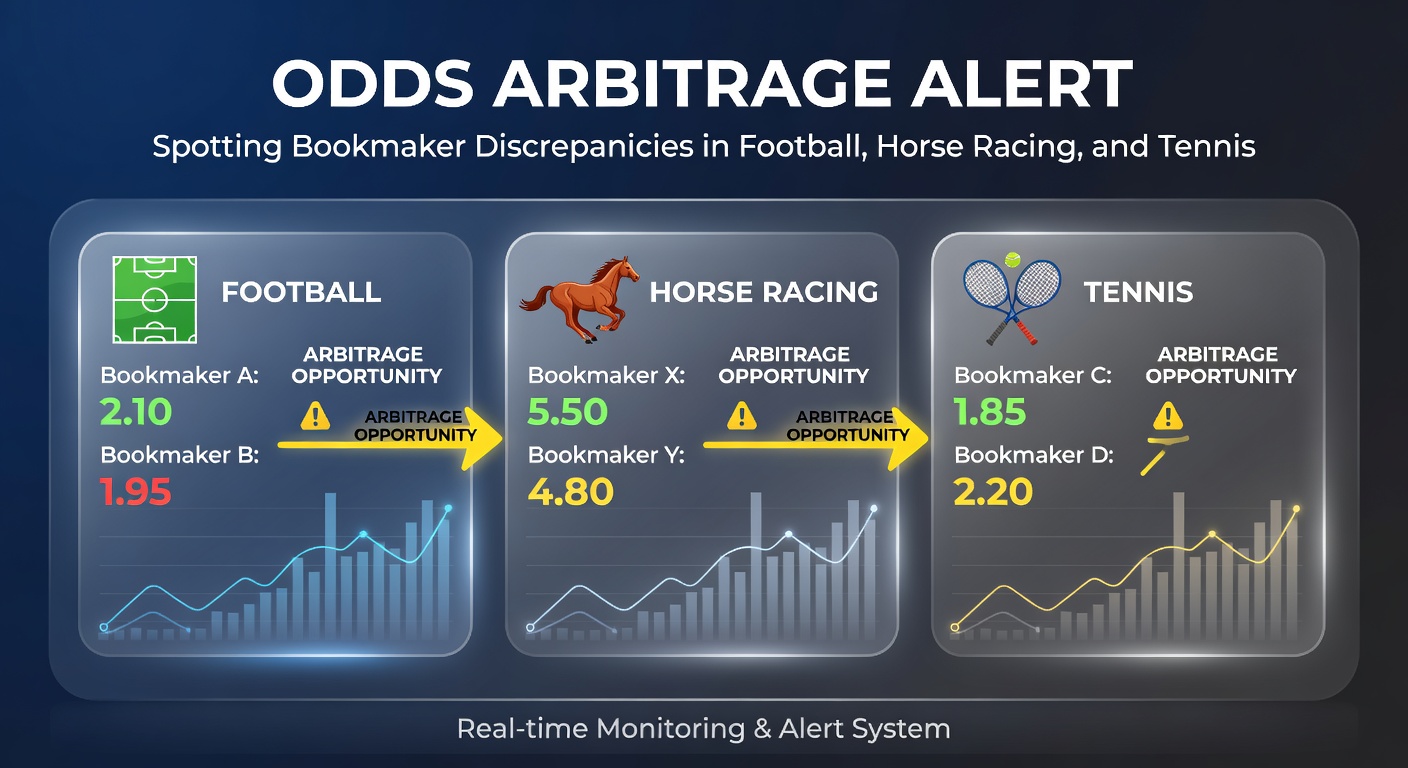
Arbitrage works simply: bettors identify events where the combined implied probabilities from different bookmakers total less than 100 percent, meaning the total stake exceeds potential payouts by a slim margin; for instance, if Bookmaker A offers 2.10 on Team X to win a football match while Bookmaker B lists 2.10 on Team Y or draw, a calculated stake split guarantees profit, typically 1-5 percent per arb.
But here's the thing—calculations demand accuracy; software scans hundreds of lines in seconds, computing stakes like this: for a £1000 total outlay, if the arb percentage hits 2.3 percent, returns net £23 no matter what, and that's before scaling up across multiple events.
Data from arbitrage tracking services reveals thousands of opportunities daily across global sportsbooks, with football leading due to its sheer volume of matches; researchers at the Australian Gambling Research Centre analyzed similar betting dynamics, finding that odds variances stem from regional differences in customer bases, where European books favor locals while Asian operators chase volume with sharper lines.
Observers note how football's outright markets, like Premier League relegation battles or Champions League qualifiers, bubble with arbs because books hedge against sharp money differently; one study highlighted a 2025 Bundesliga clash where discrepancies hit 4.2 percent across five major platforms, allowing savvy bettors to exploit before lines converged.
Football Fields: Where Discrepancies Run Wild
Football delivers prime arbs in live betting scenarios, especially during packed schedules like April 2026's FA Cup semifinals and midweek Europa League ties, when fatigue hits teams and odds swing wildly; bookmakers react to in-play events—red cards, injuries, or momentum shifts—with varying speeds, creating windows as short as 30 seconds for 2Way arbs on next goal or match winner.
Take a hypothetical Premier League derby: Bookmaker A posts 1.95 on home win post-red card, while Bookmaker B lags at 2.05 for away/draw combo; stakes adjusted proportionally yield 1.8 percent guaranteed, and with dozens of games weekly, accumulative edges build fast.
What's interesting is how international leagues amplify this—South American Copa Libertadores matches often show bigger gaps against European books, since time zones delay updates; punters who've mastered this report consistent 3-4 percent arbs during April 2026 qualifiers, when overlapping fixtures flood markets.
And yet, football's 3Way markets (home/draw/away) dominate arb volume because probabilities sum easiest; data indicates over 15 percent of daily football lines across 20+ books carry arb potential exceeding 1 percent, per aggregator scans.
Horse Racing: Sprinting Through Field-Sized Opportunities
Horse racing's massive fields—think 20+ runners in UK Classics or Australian Cups—breed discrepancies galore, as books struggle to price longshots uniformly; April 2026's Grand National buildup, with ante-post markets for the Aintree spectacle, already shows arbs in each-way bets, where place terms vary (say, 1/5 odds for top 4 vs. 1/4 top 6).
Each-way arbing shines here: one punter spots 10.0/4.0 on a nag at Book A, but 9.5/4.5 at Book B; layering both covers win or place profitably, netting 2.5 percent on average fields, and that's before live odds explode mid-race.
Turns out, international racing like Dubai World Cup carryovers into European springs create cross-hemisphere gaps; the American Gaming Association reports on similar U.S. thoroughbred variances, where tribal books diverge from Vegas lines, mirroring global patterns with arbs up to 5 percent in futures.
Live racing arbs hit hardest in sprints, where tote fluctuations clash with fixed-odds books; experts track how Australian TAB pools versus UK firms yield 1-3 percent edges during April's autumn carnivals Down Under, syncing perfectly with northern hemisphere jumps season.
So, bettors stack these, covering exotics like trifectas across platforms, but simple win-place duos suffice for reliable gains.
Tennis Tournaments: Serving Up Precise Arbs
Tennis offers clean 2Way markets—player A or B wins set/match—with fewer variables than team sports, making arbs straightforward; ATP/WTA clay seasons in April 2026, like Monte Carlo Masters or Barcelona Open, flood with live opportunities as rallies drag and fatigue sets in, prompting books to overadjust serves or breaks.
Picture a third-set tiebreak: Bookmaker A jumps to 2.20 on Player X after a break back, while Book B holds 2.15 on Y; instant 1.9 percent arb locks profit before the next point, and with matches stacking hourly, volume multiplies.
Researchers observe how women's tennis shows bigger swings due to shorter formats, with WTA 500s in April yielding average 2.4 percent arbs per round; futures markets for slams, like French Open outrights, gap wide early, as books price rankings versus form differently.
It's noteworthy that challenger events, often overlooked, harbor juiciest arbs—undercard matches with liquidity mismatches across Asian and Euro books hit 4 percent routinely, per scanner data.
Tools, Tactics, and the April 2026 Landscape
Arbers rely on scanners like OddsPortal clones or premium feeds aggregating 100+ books, alerting to 1 percent+ opportunities via apps; free trials reveal 50-200 daily arbs, but paid versions filter by stake size and sport, crucial for football's volume or racing's volatility.
Tactics evolve: round-robin arbs across multiple books minimize exposure, while VPNs dodge geo-blocks on sharp lines; in April 2026, with Euro football playoffs, Cheltenham Festival hangovers into flat racing, and clay tennis ramps, scanners report 30 percent arb uptick from fixture pileups.
People who've scaled this use stake management—never exceeding 1 percent bankroll per arb—to weather limits, as books flag consistent winners; exchanges like Betfair complement by offering lay sides, boosting hybrid arbs to 3-5 percent.
Yet limits loom: U.S. states like New Jersey cap sharp action per New Jersey Division of Gaming Enforcement guidelines, echoing global trends where regulators eye risk-free plays.
Risks That Lurk Beneath the Guarantees
Voided bets from lineup changes or errors erase arbs overnight, while account restrictions hit hardest—books void legs or limit stakes on arbers; data shows 70 percent face curbs within months, pushing pros to rotators with family/friends accounts.
Currency fluctuations nibble edges on international plays, and void rules vary wildly—tennis retirements pay differently across platforms; still, disciplined arbers net 10-20 percent annual ROI, per industry trackers.
Wrapping the Arb Playbook
Odds arbitrage stands as a mathematical certainty in discrepant bookmaker landscapes, delivering profits across football's tactical battles, horse racing's chaotic fields, and tennis's precise duels; April 2026's crowded calendars—FA Cup runs, spring racing carnivals, clay-court grinds—promise peak opportunities for those scanning diligently.
Figures confirm viability: daily arbs abound, tools democratize access, and while risks like limits persist, the math holds firm; bettors who master discrepancies turn bookie variances into their edge, proving that in betting's vast arena, gaps wait for the sharp-eyed to exploit.